


The Cabinet Media Centre published infographics on its social media platforms highlighting the main positive indicators for the Egyptian economy and the ability they reflect to cope with regional challenges, as well as developments in international credit rating agencies' assessments of the Egyptian economy and the factors supporting the stability of its credit rating.
With the challenges facing the region and their repercussions for the global economy, including pressure on energy markets, international trade and financing conditions, economic indicators that show the Egyptian economy's ability to adapt to change and contain the effects of external shocks take on added importance.
Developments in growth rates, public finances and international reserves reflect part of the Egyptian economy's performance, while assessments by international credit rating agencies highlight how these indicators and economic reforms bear on financial stability and the state's ability to meet its obligations amid continuing regional challenges.
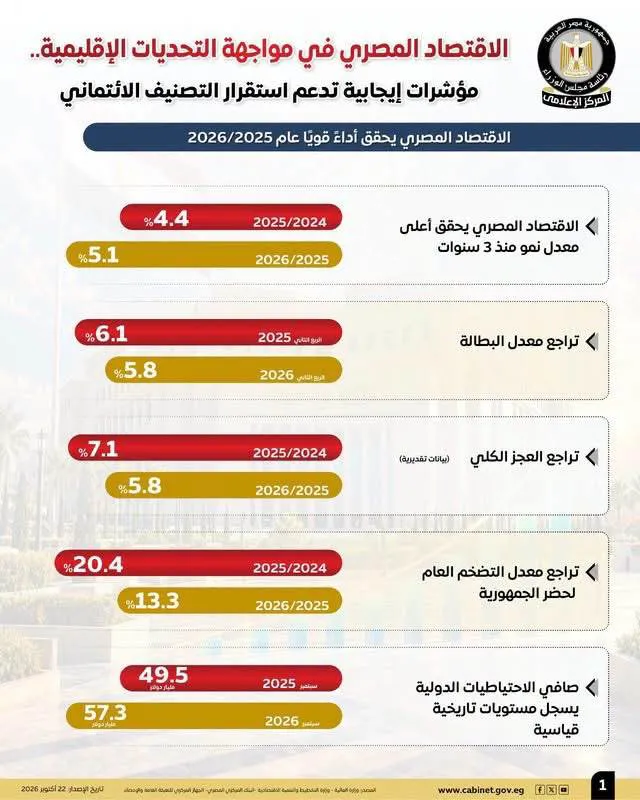
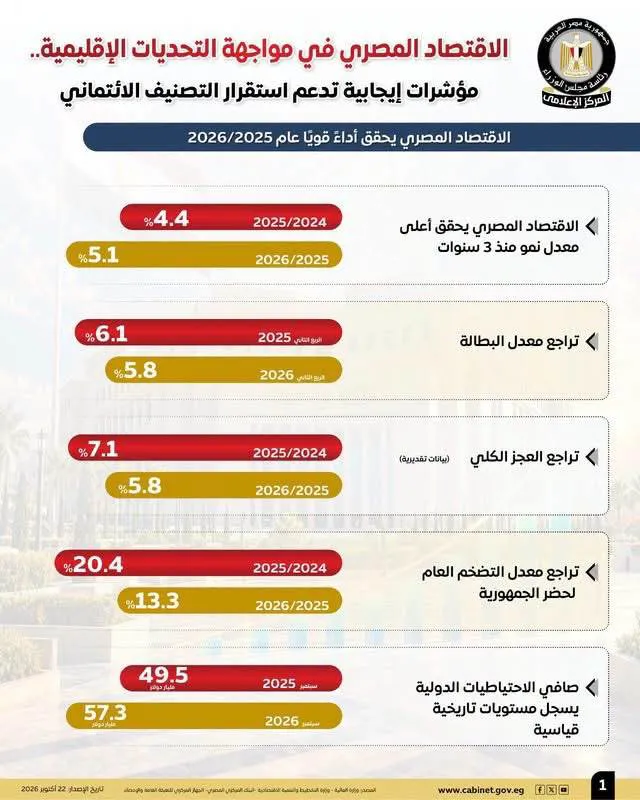
The infographics showed that the Egyptian economy performed strongly in fiscal year 2025/2026, posting its highest growth rate in three years: economic growth rose to 5.1%, compared with 4.4% in fiscal year 2024/2025.
The infographics noted that unemployment fell to 5.8% in the second quarter of 2026, from 6.1% in the second quarter of 2025, while the overall deficit narrowed to 5.8% in fiscal year 2025/2026, from 7.1% in fiscal year 2024/2025.
They added that annual urban headline inflation fell to 13.3% in fiscal year 2025/2026, from 20.4% the previous fiscal year, while net international reserves reached record highs of USD 57.3 billion in September 2026, compared with USD 49.5 billion in September 2025.
On international credit rating agencies' assessments of the Egyptian economy, the infographics reviewed developments in Egypt's ratings at Moody's, Standard & Poor's and Fitch, along with the main factors the agencies cited in their rating and outlook decisions.
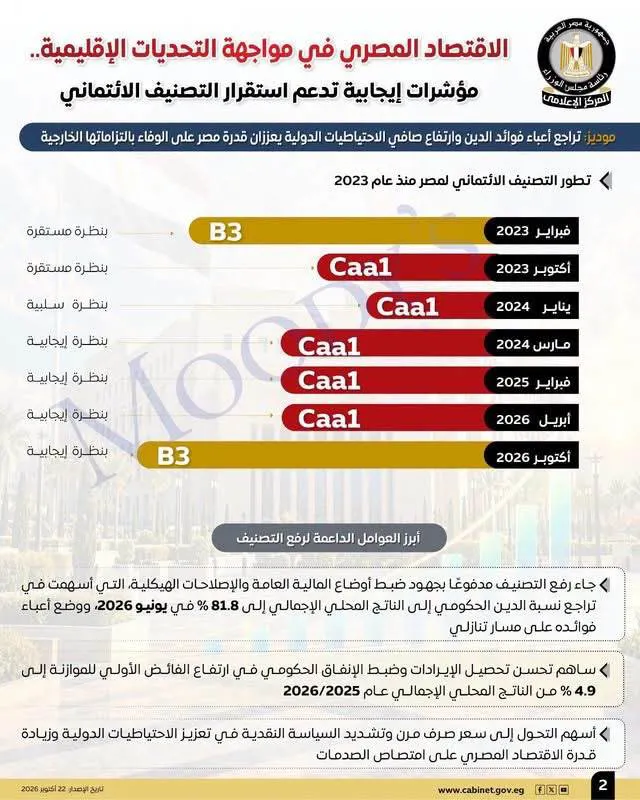
Moody's upgraded Egypt's credit rating from Caa1 to B3 in October 2026, keeping a positive outlook, on the back of improved fiscal and external indicators supported by fiscal consolidation efforts and structural reforms. According to Moody's, these efforts helped lower government debt to 81.8% of GDP in June 2026 and put interest costs on a downward path, while the primary budget surplus rose to 4.9% of GDP in fiscal year 2025/2026, thanks to better revenue collection and tighter control of government spending.
The shift to a flexible exchange rate and the tightening of monetary policy also helped strengthen international reserves and increase the Egyptian economy's capacity to absorb shocks.
The October 2026 upgrade follows a period of challenges that weighed on the agency's assessment of the Egyptian economy. Moody's downgraded Egypt from B3 in February 2023 to Caa1 in October 2023, then affirmed Caa1 in January 2024 while changing the outlook from stable to negative, before returning the outlook to positive in March 2024 with the rating affirmed. The rating remained at the same level in February 2025 and April 2026.
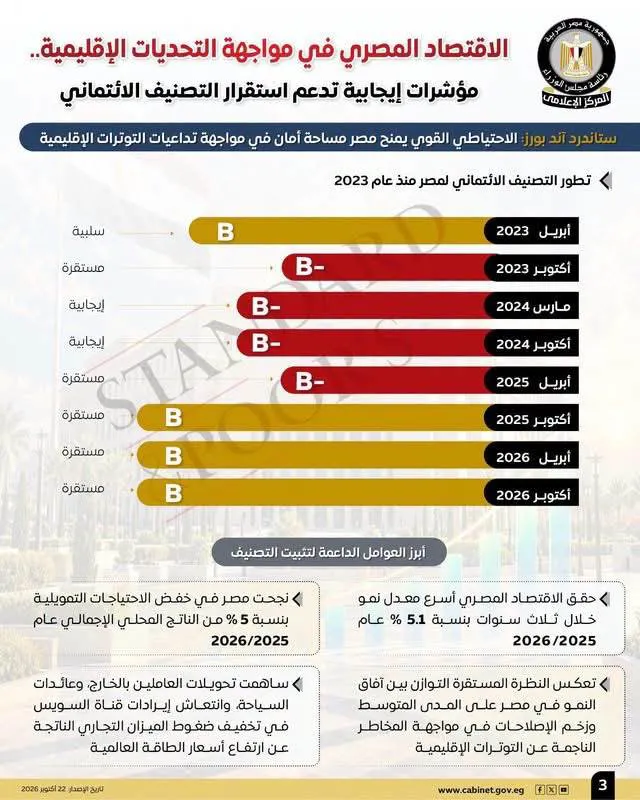
The return to B3 in October 2026 reflects improved public finances and international reserves and progress on economic reforms, supporting Egypt's ability to meet its financial and external obligations. Meanwhile, Standard & Poor's affirmed Egypt's sovereign credit rating at B in October 2026 with a stable outlook, citing the ability of international reserves to provide a safety buffer against the fallout from regional tensions, as well as the improved performance of the Egyptian economy, which grew 5.1% in fiscal year 2025/2026, its fastest growth rate in three years.
According to Standard & Poor's, remittances from Egyptians working abroad, tourism revenue and a recovery in Suez Canal revenue eased pressure on the trade balance from higher global energy prices. The agency's stable outlook reflects a balance between medium-term growth prospects and reform momentum on one hand and the risks of regional tensions on the other, as well as Egypt's success in cutting its financing needs by about 5% of GDP in fiscal year 2025/2026.
Egypt's S&P rating has seen several changes since April 2023. The agency downgraded it from B to B- in October 2023 while moving the outlook from negative to stable, then kept the rating at B- and revised the outlook to positive in March 2024. It affirmed the rating and kept the positive outlook in October 2024, before returning the outlook to stable in April 2025 while affirming the rating at B-.
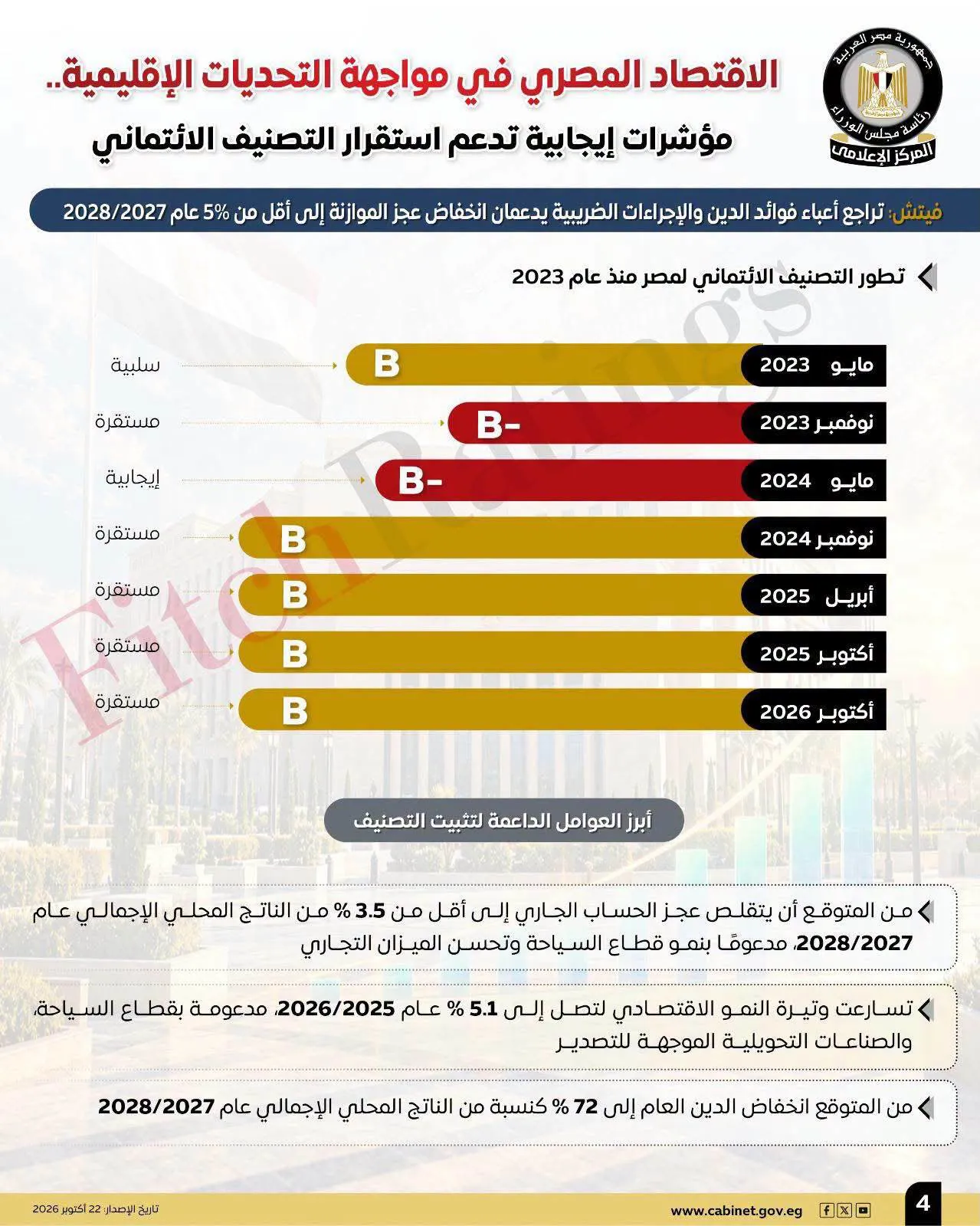
In October 2025, the agency upgraded the rating to B with a stable outlook, and the rating stayed at that level in April and October 2026, reflecting the Egyptian economy's improved ability to withstand external pressure. Fitch, for its part, kept Egypt's sovereign credit rating at B in October 2026 with a stable outlook, supported by expectations of improving fiscal and external indicators as interest costs fall and tax measures help bring the budget deficit below 5% of GDP by fiscal year 2027/2028. The agency also expects the current account deficit to narrow to below 3.5% of GDP in fiscal year 2027/2028, supported by growth in tourism and an improved trade balance, and public debt to fall to about 72% of GDP. This comes as Egypt's economic growth accelerated to 5.1% in fiscal year 2025/2026, driven by tourism and export-oriented manufacturing.
The affirmation at B follows a series of changes to Egypt's credit rating since May 2023. Fitch downgraded the rating from B to B- in November 2023 while changing the outlook from negative to stable, amid external financing pressures and foreign-currency liquidity challenges.
In May 2024, the agency kept the rating at B- and revised the outlook from stable to positive, before upgrading the rating to B in November 2024 with a stable outlook. The rating stayed at that level in April and October 2025, and again in October 2026. This trajectory reflects improved expectations for the performance of the Egyptian economy and public finances and for the country's ability to withstand external pressure.

Comments
No comments yet. Be the first!