
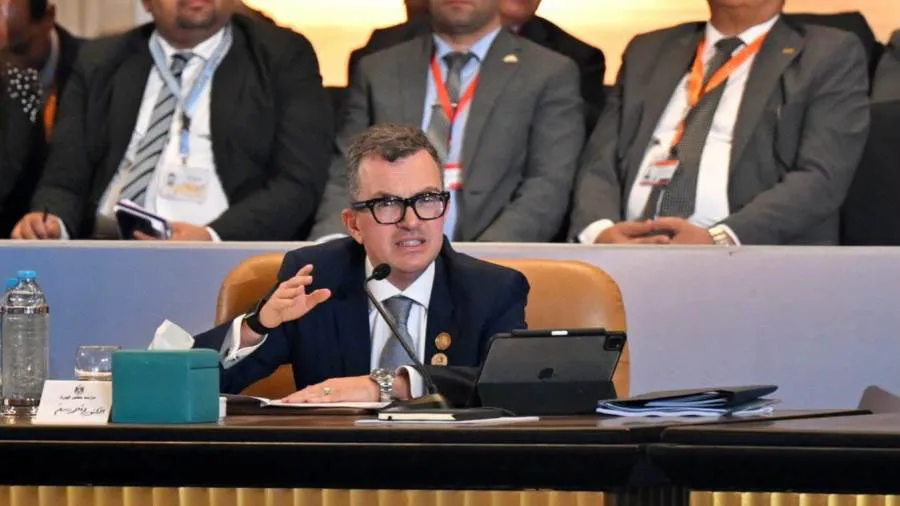
Dr. Ahmed Rostom, Minister of Planning and Economic Development, took part in a panel discussion on "Foreign Currency Resources and Debt Management" as part of the economic track on the fourth day of the Egypt Forum 2026. The session covered controlling the borrowing path and diversifying funding sources, as well as strengthening the Egyptian economy's ability to grow its own resources sustainably.
The session drew high-level participation, including Hassan Abdalla, Governor of the Central Bank of Egypt (CBE); the ministers of finance, civil aviation, investment and foreign trade, and tourism and antiquities; the President's adviser for economic affairs; and the chairman of the Suez Canal Authority, along with a group of bank chiefs, members of the House of Representatives and the Senate, and economic experts. It was moderated by broadcaster Dina Salem.
During the session, Dr. Ahmed Rostom outlined the general framework for managing external debt, stressing the importance of approaching the issue from an integrated perspective that looks not only at the size of the debt but also at its structure and servicing burden, in support of a sustainable financing path.
He stressed that the state handles external borrowing requests with the utmost precision and controls, in line with presidential directives to study them, review the related feasibility studies and ensure repayment capacity before approving them. The goal, he said, is to put external debt on a gradual downward path, so that repayments exceed new borrowing.
Dr. Rostom pointed to the pivotal role of the Ministry of Planning and Economic Development, as head of the technical secretariat of the "External Debt Management Committee", in borrowing governance. The committee studies financing requests institutionally to ensure they are consistent with the state's priorities, and assesses the available alternatives to choose the most suitable in terms of cost and terms. He also noted that Egypt's sovereign rating is stable and that it has received positive assessments from three international credit rating agencies, reflecting the success of the state's efforts to improve the management of its external obligations.
Dr. Rostom explained that the path to debt sustainability depends on the economy's ability to grow its resources, stressing the need to support real-economy sectors such as industry, tourism, and communications and information technology. He added that boosting local production and deepening value chains contribute directly to import substitution, reduce future financing needs and achieve a strategic balance between the services and productive economies.
The Minister of Planning and Economic Development concluded by revealing that the state is studying new financing mechanisms with international institutions, especially for infrastructure projects, to ease pressure on foreign currency. He cited the "Infrastructure Project Financing Guarantee Mechanism", alongside policies to rationalize government spending in dollars and make the most of existing infrastructure.

Comments
No comments yet. Be the first!