

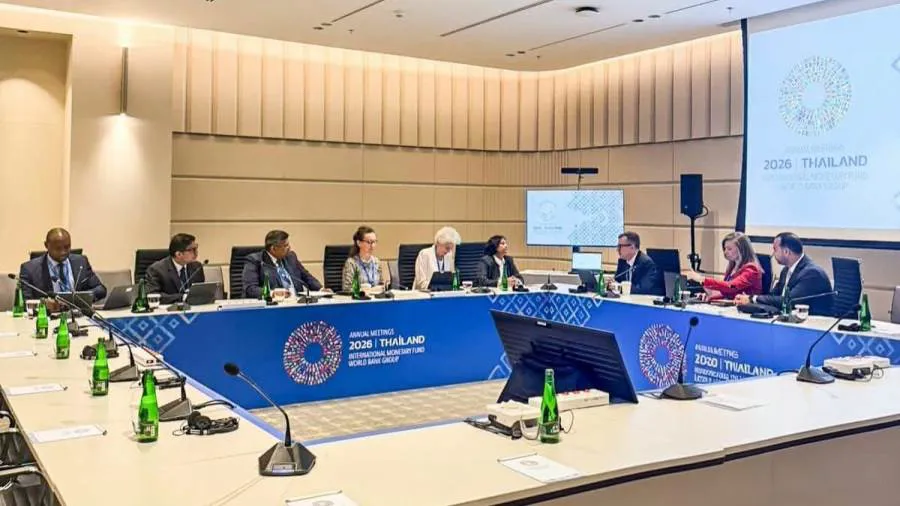
On the sidelines of the Bangkok meetings, the Minister of Planning and Economic Development discussed with the World Bank's managing director progress on developing innovative local-currency financing mechanisms
Dr. Ahmed Rostom: We aim to launch an "Infrastructure Financing Guarantee Mechanism" to reduce investment risk and ease the burden on the state budget.
Indicators of the Egyptian economy's resilience and the outlines of the "National Economic Transformation Program" were presented to World Bank leaders.
Dr. Ahmed Rostom, Minister of Planning and Economic Development, held a high-level meeting with Anshula Kant, Managing Director and Chief Financial Officer of the World Bank Group, to discuss prospects for cooperation and strengthening the development partnership. The meeting took place on the sidelines of his participation in the busy program of the World Bank Group and International Monetary Fund Annual Meetings in the Thai capital, Bangkok.
During the meeting, the minister reviewed the Egyptian economy's performance indicators, stressing its growing capacity to absorb shocks and achieve positive growth rates despite a complex global economic landscape and regional geopolitical tensions.
Dr. Rostom also presented to the World Bank's senior management the main features of the "National Economic Transformation Program", which the Egyptian government is currently drafting in line with presidential directives. The program aims to entrench macroeconomic stability and build on the gains of recent structural reforms, with a focus on stimulating investment and production.
The meeting included in-depth discussions on the implementation steps for the "Infrastructure Projects Financing Guarantee Mechanism" being developed in partnership with the World Bank. Dr. Ahmed Rostom stressed the importance and priority of this mechanism, explaining that it represents a step change in attracting private investment and providing innovative, long-term financing solutions in local currency.
The minister affirmed that activating the mechanism is directly aimed at reducing investment risk for the private sector, which will effectively help raise the efficiency of public spending, ease financing pressures on the state budget and support the sustainability of infrastructure projects.

Comments
No comments yet. Be the first!