
Dr. Hussein Eissa: Continued government efforts towards a more competitive, productive and sustainable economy and a stronger private-sector role, with improving citizens' quality of life and raising the efficiency of services top priorities
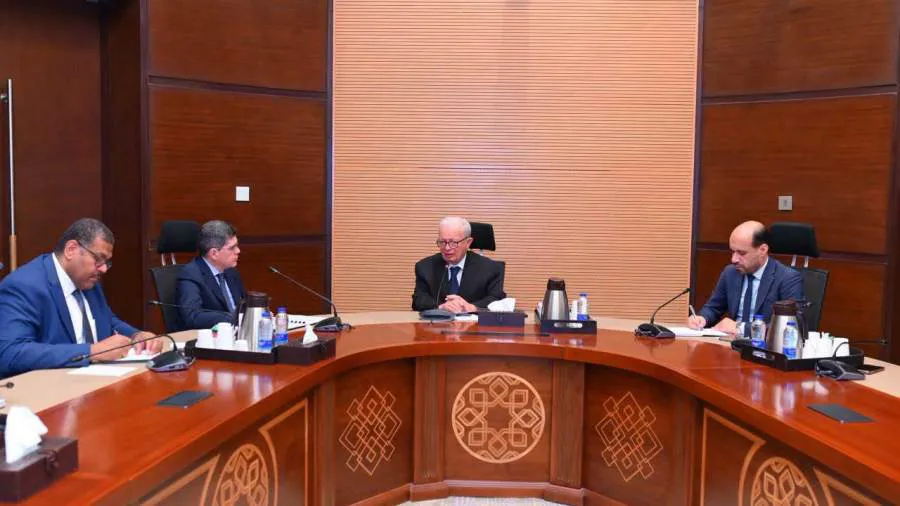
Dr. Hussein Eissa, Deputy Prime Minister for Economic Affairs, received Pablo Saavedra, World Bank Group Vice President for Prosperity, and his accompanying delegation at the government headquarters in the New Capital. The meeting discussed ways to strengthen cooperation and opportunities to widen the partnership in the coming period.
At the start of the meeting, Dr. Hussein Eissa welcomed the World Bank Group Vice President and his delegation, stressing the deep, long-standing relations and strategic partnership between the Egyptian government and the World Bank Group, and their ongoing cooperation in various fields that serve the Egyptian economy and support sustainable development efforts. He praised the projects the group is implementing in Egypt and expressed Egypt's hope of continuing fruitful development cooperation that supports the state's efforts to raise citizens' living standards.
The Deputy Prime Minister said the Egyptian economy continues to post positive performance indicators despite regional tensions and global geopolitical and economic challenges, reflecting its adaptability and resilience in the face of international and regional changes. He noted that the government is pressing ahead with efforts towards a more competitive and productive economy, sustainable economic growth, higher investment and production, and deeper local manufacturing, stressing that the main aim of the reforms is to raise citizens' living standards and quality of life, with a focus on improving the quality of services.
He pointed out that the government is implementing an integrated package of policies and measures to stimulate investment, support start-ups and entrepreneurship, and enable the private sector to take a broader and more effective part in economic and development activities, as a key partner in achieving sustainable growth, raising investment rates and creating jobs.
Dr. Hussein Eissa reviewed the main areas of work under way, including preparing the National Programme for Economic Transformation (2027–2030) ahead of its launch by the end of this year, launching the second edition of the State Ownership Policy Document (2026–2030), and continuing to implement the government offerings programme.
He said preparations are under way to begin pilot implementation of programme and performance budgeting from fiscal year 2027/2028, as part of the state's drive to develop its public financial management system and use public resources more efficiently. He added that this represents a qualitative leap in the efficiency of public spending and in monitoring and evaluation mechanisms, by linking government funding to actual performance and results, which will directly improve the quality of services provided to citizens and strengthen the ability to measure development impact.
The Deputy Prime Minister also referred to an integrated programme to reform, restructure and improve the performance of companies and economic authorities, based on strengthening efficiency, effectiveness and governance and applying modern best practices in corporate management, to raise productivity and maximise the economic return on public assets. He explained that the companies previously under the Ministry of Public Business Sector are being reorganised following the ministry's abolition, as part of an integrated vision to improve their performance, competitiveness and capacity for growth and expansion, strengthen their operational and financial efficiency and governance, and increase their contribution to the national economy and to comprehensive and sustainable development targets.
Dr. Hussein Eissa added that efforts are also continuing to reform and restructure economic authorities, based on a comprehensive study of their situation. Its recommendations include restructuring many of these authorities in financial, administrative, legislative, marketing and other respects, merging some, converting others into public service authorities and abolishing others, under an integrated institutional vision aimed at raising performance efficiency, strengthening effectiveness and improving the quality of services.
For its part, the World Bank delegation expressed its appreciation for the excellent relations between Egypt and the World Bank Group, praising the Egyptian economy's indicators and the flexibility and resilience it has shown amid current regional and international challenges. The delegation also expressed its hope of strengthening cooperation and joint work between the two sides to support development efforts and economic and structural reforms, increase the competitiveness of the Egyptian economy and empower the private sector.

Comments
No comments yet. Be the first!