
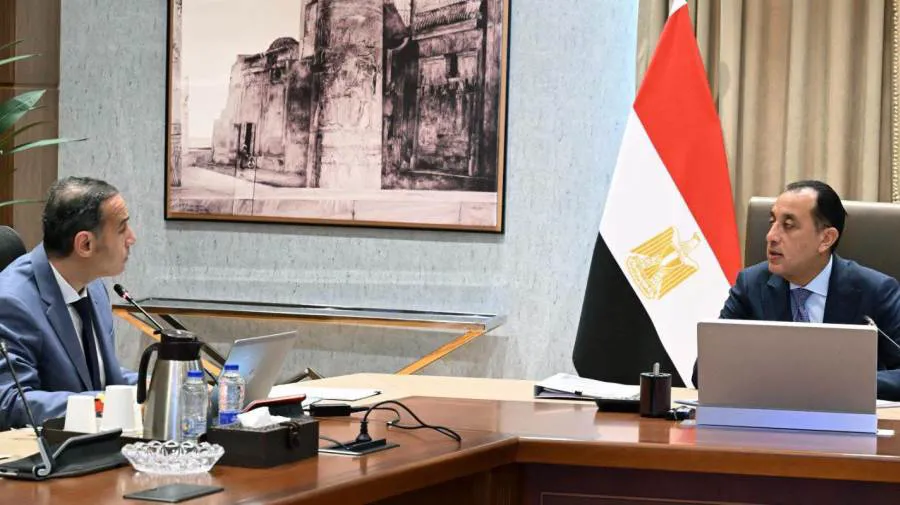
Prime Minister Dr. Mostafa Madbouly met yesterday evening in the New Capital with Dr. Islam Azzam, Chairman of the Financial Regulatory Authority (FRA), to follow up on developments in the non-bank financial sector and the activities under the FRA's supervision. The meeting also covered the FRA's latest steps, within its supervisory and regulatory powers, to improve the efficiency of the capital market, insurance and non-bank finance, grow these activities' contribution to the national economy and protect clients' rights.
At the start of the meeting, the Prime Minister affirmed the state's commitment to developing all activities of the non-bank financial sector, given its vital role in driving the national economy, attracting investment and broadening the participation of the local and foreign private sector. The sector also offers citizens safe investment channels under the FRA's full supervision, particularly the Egyptian Exchange and licensed investment funds.
Dr. Mostafa Madbouly noted that protecting the rights of clients in this sector is one of the state's top priorities. This is reflected in the regulatory framework for these activities and the successive decisions issued by the FRA, keeping pace with market developments and the growing number of people using the sector's various activities, such as insurance and non-bank finance.
During the meeting, the FRA Chairman reviewed the latest updates to the regulatory frameworks for these activities, namely recent decisions to improve service quality and meet citizens' needs, strengthen supervisory performance, and support the ability of the FRA and the sector's institutions to detect, confront and curb harmful practices early. This helps resolve clients' problems faster, inform them of their rights and protect their assets.
The FRA Chairman highlighted a number of recent FRA decisions and their direct aims, such as strengthening safeguards for responsible lending and curbing defaults, fraud, impersonation and money laundering. These include requiring finance providers to use one-time passwords (OTP) to tighten verification of the client's identity and ensure the client is aware of the procedures and consents to the terms, including when financing is disbursed and used; mandating a real-time link with the credit bureau; and requiring consumer finance companies to check clients' behavioral-analysis-based scores and to put in place the technology infrastructure needed to link their databases with the FRA's database.
Dr. Islam Azzam explained that the full link now being organized and implemented between the FRA and all companies under its supervision will provide real-time and daily data from various markets and allow advanced analysis using AI technologies, with part of the results made available to the market to help companies make more efficient decisions and improve the quality of insurance and financing products according to clients' actual needs.
In this regard, the FRA Chairman said that giving clients all the information about an insurance or financing product or other investment vehicles, and informing them of their rights and obligations, are core pillars of non-bank financial activities, along with data protection and effective complaint and grievance mechanisms. He added that these pillars help measure the real impact of financial services on clients' lives and economic activities.
He also pointed to recent decisions and instructions aimed at preventing misleading information and confusion between different savings and investment products, and banning marketing phrases or practices that give clients false impressions.
He added that the FRA's pursuit of financial inclusion targets under "Egypt Vision 2030" starts from the need to protect and empower the most vulnerable groups. The FRA therefore strikes a careful balance between two complementary goals: helping these activities thrive by expanding access to finance and fostering innovation and competition, and protecting clients so that the desired growth is responsible and sustainable and does not burden clients with risks or obligations beyond their means.
The meeting also covered the FRA's efforts to raise companies' efficiency and widen the scope of risk management beyond credit risk to include market and operational risk. He noted that "Basel III" standards will soon be applied to the non-bank finance sector from January, and pointed to a recent decision on underwriting and pricing rules for credit and surety insurance policies, which includes clear standards and strict controls for developing reinsurance and risk management policies.
The meeting also discussed developments that offer attractive investment opportunities, the latest and upcoming offerings on the Egyptian Exchange, particularly of state-owned companies slated for listing under the State Ownership Policy Document, and the FRA's role in building the capacity of these companies' staff and training them on the practical requirements for moving from temporary to final listing, including governance, disclosure and transparency requirements.
During the meeting, Dr. Islam Azzam pointed to ongoing preparations to launch a mechanism for selling borrowed securities (short selling) and the importance of offering it alongside margin trading to improve price discovery, boost trading activity and attract new categories of investors, especially foreigners and young people. He noted that this complements the launch of the derivatives market last March and the recent regulation of hedge funds, forming an integrated path to modernize the capital market with rules that ensure full transparency and governance and protect the rights of all parties.
Notably, the number of new investors registered with codes on the Egyptian Exchange exceeded 171,000 by the end of the second quarter of this year, and trading value exceeded EGP 6.4 trillion, up about 78.3% from the second quarter of last year.
Investment funds, meanwhile, recorded 14.7% growth in net asset value by the end of the second quarter of this year, reaching EGP 471 billion across 224 funds. The number of fund units rose to 44 billion, 75% of them held by individuals, reflecting growing confidence in funds as one of the most important investment tools in Egypt recently.
#EgyptianCabinet

Comments
No comments yet. Be the first!