
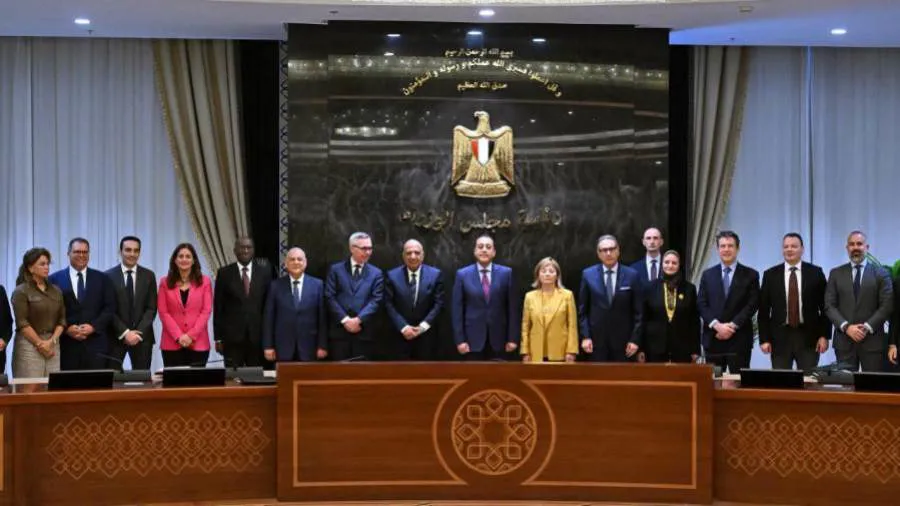
Prime Minister Dr. Mostafa Madbouly this evening witnessed, at the government headquarters in the New Capital, the signing of a term sheet to finance the "Dandara" solar project in Nag Hammadi, Qena Governorate. The project has a capacity of 1000 MW plus 200 MWh of batteries, with total investments of around USD 650 million. The term sheet was signed between Norway's Scatec and the European Investment Bank, the European Bank for Reconstruction and Development and the African Development Bank. Agreements were also signed to connect the project to the national electricity grid and for the National Bank of Egypt (NBE) to take a stake in the project company, in the presence of Dr. Mahmoud Esmat, Minister of Electricity and Renewable Energy.
The term sheet for financing the "Dandara" solar project was signed by Terje Pilskog, CEO of Norway's Scatec; Gelsomina Vigliotti, Vice-President of the European Investment Bank; Mark Davis, Regional Managing Director for the Southern and Eastern Mediterranean at the European Bank for Reconstruction and Development; and Abdourahmane Diaw, Country Manager for Egypt at the African Development Bank.
The agreement on connecting the project to the national grid, use of the grid and supervision of the construction of the connection lines was signed by Eng. Mona Rizk, Chairwoman of the Egyptian Electricity Transmission Company; Eng. Mohamed El-Saadawy, Chairman of the Metallurgical Industries Holding Company; and Mohamed Amer, Chairman of Dandara Solar Energy.
The agreement for NBE's stake in Dandara Solar Energy was signed by Eng. Mohamed Amer, Chairman of Dandara Solar Energy, and Ahmed El-Saeed, Head of Investment at the National Bank of Egypt.
The project's total capacity is 1000 MW (1 GW) of solar power, plus a battery energy storage system with a total capacity of 200 MWh, with investments estimated at around USD 650 million. It will be built in two phases: the first comprises a 500 MW solar plant with 100 MWh of battery storage, and the second adds a further 500 MW of solar capacity and 100 MWh of batteries.
The project aims to supply around a third of the electricity needs of Egyptalum (Misr Aluminium), a subsidiary of the Metallurgical Industries Holding Company, helping cut carbon emissions from aluminum production and boosting the competitiveness of Egyptian products and their access to global markets, especially given rising environmental requirements for exports. The signings mark an important step toward completing the financing and implementation arrangements for the project, one of Egypt's most prominent renewable energy projects dedicated to supplying industry. It reflects cooperation between the Egyptian government, Scatec, international financial institutions and national banks to support the shift to clean energy, reduce carbon emissions and strengthen the competitiveness of Egyptian industry and its exports in global markets.
Comments
No comments yet. Be the first!