
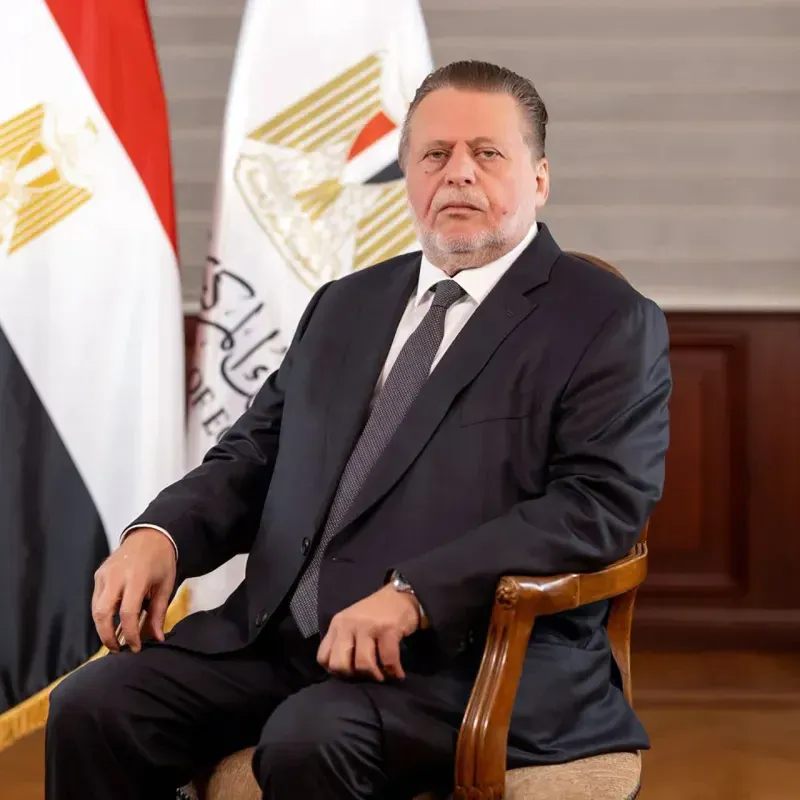
Since taking charge of the Central Bank of Egypt (CBE) on 18 August 2022, Hassan Abdalla has led the institution through a period marked by pressure on foreign-currency resources, rising inflation and challenges posed by global economic and geopolitical developments. The files the CBE handled during this period ranged from managing monetary policy and the foreign-exchange market to developing digital banking services, promoting financial inclusion and sustainable finance, and supporting entrepreneurship and international financial cooperation.
This profile reviews the main milestones, decisions, initiatives and documented personal awards during his tenure, from August 2022 to October 2026.
More than four decades of banking and academic experience
Hassan Abdalla began his career at Arab African International Bank (AAIB) in 1982, after earning a bachelor's degree in business administration from the American University in Cairo, followed by an MBA from the same university in 1992. He rose through the banking ranks to become CEO and Vice Chairman of AAIB, and was part of the team that implemented Egypt's banking reform programme in the early 2000s.
His previous roles include eight years on the CBE's board of directors, membership of the Egyptian Exchange board, and chairmanship of the Union de Banques Arabes et Françaises (UBAF) in Hong Kong. He is the founder and chairman of the board of trustees of the Wafaa Le Masr Foundation, founder and former chairman of the Egyptian Junior Business Association, and a founding member of the Egyptian National Competitiveness Council.
Before being tasked with leading the CBE, he had chaired United Media Services since May 2021. His experience also extends to academia: his official biography notes 30 years on the faculty of the American University in Cairo and membership of the strategic advisory board of its business school.
Continuing in office for a fifth year
Hassan Abdalla became acting governor of the CBE in August 2022. In 2026, Presidential Decree No. 339 of 2026 renewed his mandate for one year from 18 August 2026, extending his tenure into a fifth consecutive year after four years of shifts in monetary policy and banking services.
2022: Managing liquidity and reviewing import-financing rules
The first months of his tenure saw monetary and regulatory tools used to address economic pressures. In September 2022, the reserve requirement on local-currency deposits was raised from 14% to 18%, helping control liquidity in the banking system and complementing the effect of monetary policy.
On 27 October 2022, the CBE announced a move to a flexible exchange-rate regime, allowing supply and demand to determine the pound's value against foreign currencies, while prioritising price stability and building adequate foreign reserves.
The statement also began the gradual phase-out of the instructions requiring letters of credit to finance imports, with the aim of removing them completely by December 2022, as part of a review of foreign-trade financing rules.
2023 and 2024: Fighting inflation and reforming the FX market
Throughout 2023, monetary policy continued to confront inflationary pressures, while monitoring the effect of interest rates and liquidity on the economy. Monetary Policy Committee (MPC) statements during this phase stressed the need to maintain tight monetary conditions to achieve price stability over the medium term.
6 March 2024 was a key milestone of his tenure: at an extraordinary meeting, the MPC raised key interest rates by 600 basis points, to 27.25% for the overnight deposit rate, 28.25% for the overnight lending rate and 27.75% for the main operation, alongside a shift to a market-determined exchange rate.
These measures were part of a broader economic reform package covering monetary and fiscal policy and cooperation with the International Monetary Fund. An IMF report issued in March 2024 documented the role of the Ras El Hekma deal in providing financing inflows and converting part of the UAE deposits held at the CBE into investments, supporting foreign-currency resources alongside the FX market reform.
2025 and 2026: Shifting to rate cuts while monitoring inflation risks
As inflation changed course, the MPC began cutting interest rates on 17 April 2025 by 225 basis points, to 25% for the deposit rate, 26% for the lending rate and 25.5% for the main operation. The statement linked the decision to lower headline and core inflation and improved expectations, while continuing to assess risks around the price outlook.
By its 24 September 2026 meeting, the committee held rates at 19% for the deposit rate, 20% for the lending rate and 19.5% for the main operation. This path highlights how monetary policy moved during his tenure between tightening, easing and holding, depending on inflation and the economic outlook.
Annual urban headline inflation stood at 14.5% in August 2026, compared with 14.9% in July. The committee's statement attributed the decline mainly to lower food inflation, which offset the effect of higher electricity tariffs and rents.
Stronger foreign reserves and higher remittances from Egyptians abroad
Egypt's net international reserves reached about USD 57.2145 billion at the end of August 2026, according to preliminary CBE data, compared with USD 51.4516 billion at the end of December 2025. Calculating the difference between the two figures, the increase was about USD 5.763 billion, equivalent to growth of nearly 11.2%.
Remittances from Egyptians working abroad totalled about USD 29.7 billion in January–July 2026, up 28.1% from about USD 23.2 billion in the same period of 2025. These indicators reflect improved foreign-currency resources, with economic policies, FX market conditions and external inflows all contributing to the results.
Developing digital banks and electronic financial identity
Under Hassan Abdalla's leadership, the CBE's work extended to setting rules that keep pace with the changing shape of banking services. In July 2023, it issued rules for licensing, registering, regulating and supervising digital banks, providing a regulatory framework for delivering banking services through digital channels and platforms.
In August 2026, the CBE's board approved the rules governing the digital financial identity system for identifying bank customers and verifying their identities electronically (eKYC), laying the groundwork for wider access to remote banking services in line with regulatory controls and identity-verification requirements.
Expanding instant payments and mobile services
His tenure saw continued development and wider use of the Instant Payment Network. In December 2024, the CBE announced that incoming transfers from abroad could be received instantly into bank accounts through the network.
The network was launched in March 2022, before he took office, while work on developing it and expanding its services and reach continued under his leadership.
Also in December 2024, Egypt launched payment-card tokenisation on mobile apps and activated Apple Pay as a first phase, to expand the use of phones in digital payments and enhance transaction security.
According to statements by Hassan Abdalla published on 1 October 2026, the number of customers registered on the Instant Payment Network reached about 22 million by the end of the second quarter of 2026, and the network recorded 1.47 billion transactions worth about EGP 4.33 trillion.
Promoting financial inclusion and access for wider groups
The CBE and the financial sector continued working to increase use of formal financial services. By the end of June 2026, the financial inclusion rate reached 79%, representing 56.4 million citizens with active accounts out of 71.4 million citizens aged 15 and over, while the financial inclusion rate for women reached 72.5%.
This indicator covers bank and postal accounts, mobile wallets and prepaid cards, and reflects cumulative institutional efforts that began before he took office and continued during his tenure.
In February 2026, the CBE announced it was drafting the second financial inclusion strategy for 2026–2030, to build on previous efforts and guide work over the coming years.
Supporting entrepreneurship, innovation and young talent
During his tenure, non-financial services for businesses continued to develop through the business development service centres of the Nilepreneurs initiative. In February 2026, the CBE announced that non-financial and advisory services had exceeded 1.16 million, benefiting about 502,000 people, including 210,000 women, and facilitating access to about EGP 19 billion in financing for more than 14,000 projects with the participation of 18 banks. These figures are cumulative for the initiative.
In September 2026, the CBE launched the fourth edition of the "FinTech Got Talent" competition for university students, under the "FinYology" initiative, to support innovative fintech ideas and projects.
Cooperation with the Ministry of Higher Education extended to the "Future Scientists Scholarship" initiative supporting high-achieving students in social need. According to an official statement in February 2026, the first phase provided full scholarships to 1,953 students, and preparations were then discussed to receive a new cohort in the 2026/2027 academic year.
Sustainable finance and environmental and social risk management
In November 2022, the CBE issued binding instructions to strengthen sustainability and sustainable finance at banks, building on the guiding principles issued in July 2021. The framework included setting up specialised departments and integrating environmental and social considerations into banking policies and activities.
In August 2026, the CBE began preparatory steps to issue a "sustainable finance taxonomy", forming a working group of ministries and relevant bodies, with the aim of providing a framework for identifying sustainable economic activities and supporting investor confidence.
International presence and African cooperation
Hassan Abdalla has represented Egypt as the Arab Republic of Egypt's Governor at the International Monetary Fund, under Prime Ministerial Decree No. 938 of 2026, published on 31 March 2026. The CBE documented his participation in that capacity at the IMF and World Bank Spring Meetings in April of the same year.
At the African level, the CBE announced in July 2026 the publication of the first continent-wide financial stability report, prepared under his chairmanship of the relevant working group of the African Financial Stability Board, supporting the exchange of expertise and better regional monitoring of financial risks.
Building trust in Africa
Speaking on the sidelines of the El Alamein–Africa Forum, CBE Governor Hassan Abdalla said Africa needs to build trust, strengthen joint financial cooperation and create enough jobs to absorb its rapidly growing youth population, which is at once the continent's greatest opportunity and its most important responsibility. He noted that about 12 million young people enter Africa's labour market each year, while only about 3 million formal jobs are created, which calls for equipping them with the education and skills they need so they become a driving force for economic growth rather than a challenge to it.
The Governor urged African countries to adopt stable and predictable economic policies, along with clear economic frameworks and specific, measurable plans, to strengthen credibility and give investors and businesses a clear view of what to expect. He stressed that building confidence in the economy is essential to attracting investment and achieving sustainable growth.
Growth of the banking sector
Data published for the first half of 2026 showed that total assets of banks operating in Egypt, excluding the CBE, reached about EGP 27.661 trillion, with total capital of about EGP 739.164 billion. These indicators reflect the nominal expansion of the banking sector, while assessing its soundness also requires looking at capital adequacy, asset quality, liquidity and profitability.
As for the CBE's own financial statements, its net profit reached EGP 144.543 billion at the end of May 2026. The CBE's performance, however, is judged mainly by price stability and the soundness of the monetary and banking system, alongside its published financial indicators.
Supporting Egyptian industry
CBE Governor Hassan Abdalla and Minister of Industry Eng. Khaled Hashem announced the launch of the "Distressed Factories Restructuring Fund", with total capital of EGP 1 billion. The fund aims to take equity stakes in distressed industrial facilities in Egypt with promising operating fundamentals and to restructure them, helping restore their operational efficiency, strengthen their capacity for growth and sustainability, and maximise their long-term value.
The fund follows a specialised investment strategy targeting factories and industrial facilities facing financial or operational challenges despite having assets and production capacity that can be developed. Its specialised team works with the facilities' executive management to implement integrated restructuring plans, including loan restructuring, fresh capital injections, and programmes to raise operational efficiency and strengthen governance, helping restore productive efficiency, preserve jobs and support the competitiveness of Egyptian industry.
Awards and honours received by Hassan Abdalla during his tenure
Central Bank Governor of the Year for Africa 2025 from The Banker
The Banker, part of the Financial Times group, named Hassan Abdalla "Central Bank Governor of the Year for Africa 2025", announcing the award on 2 January 2025. The honour recognised his role in restoring a degree of stability to the Egyptian economy, moving to a more flexible exchange rate and handling monetary pressures, as well as improved communication with markets around the March 2024 decisions.
"Governor of the Year 2025" award from the Union of Arab Banks
Hassan Abdalla received the "Governor of the Year 2025" award from the Union of Arab Banks at the International Arab Banking Summit in Paris in June 2025, in recognition of his role in managing monetary policy, strengthening banking-sector stability and supporting economic reform. At the ceremony, he said the award reflects the joint efforts of the CBE, the banking sector and the Egyptian government.
Among the world's top central bank governors for 2025 from Global Finance
Hassan Abdalla received an A− grade in Global Finance magazine's "Central Banker Report Cards 2025", placing him among the governors with the highest grades. Deputy Governor Rami Aboul Naga accepted the award on his behalf at a ceremony in Washington in October 2025.
This followed a B+ grade in the magazine's 2024 report, a professional rating noted as part of the progression of his standing with the magazine rather than counted as a separate award.
"Person of the Year – Institutional Achievement" award at Egypt's Best Summit 2026
The 11th edition of Egypt's Best Summit honoured Hassan Abdalla with the "Person of the Year – Institutional Achievement" award, in recognition of his efforts in leading monetary reform and strengthening economic and banking stability. Mai Abou El Naga, First Sub-Governor of the CBE, accepted the award on his behalf.
Nomination for African Central Bank Governor of the Year 2025 from AFIS
His professional honours included a nomination for the African Central Bank Governor award at the Africa Financial Industry Summit (AFIS) Awards 2025. It is a nomination documented on the official list,

Comments
No comments yet. Be the first!