
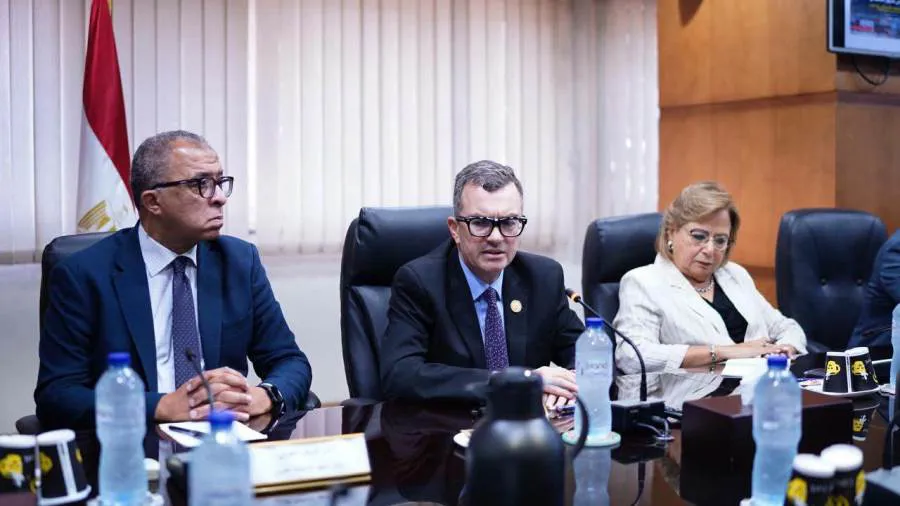
Dr. Ahmed Rostom, Minister of Planning and Economic Development, held an expanded meeting at the headquarters of the Institute of National Planning with a group of economists, academics and members of the House of Representatives and the Senate, to review economic performance indicators and the performance of the economic and social development plan for the current fiscal year 2026/2027.
The meeting was attended by Dr. Ashraf El-Araby, head of the Institute of National Planning; Dr. Naglaa El-Ahwany, former Minister of International Cooperation; Dr. Alia El-Mahdy, economist and former dean of the Faculty of Economics and Political Science; Dr. Medhat Nafea, economist; Dr. Samiha Fawzy, former Minister of Trade and Industry; Dr. Rasha Ramadan, professor of economics; Dr. Fakhry El-Feky, former head of the House of Representatives' Plan and Budget Committee; MP Akmal Nagaty; Dr. Nihal El-Megharbel, professor of economics and former member of the Senate; and Dr. Nagwa Samak, professor of economics and dean of the Faculty of Administrative Sciences at Galala University.
During the meeting, Dr. Ahmed Rostom reviewed developments in the Egyptian economy and progress on implementing the economic and social development plan for the current fiscal year 2026-2027, noting that the Egyptian economy has proved able to adapt to global and regional geopolitical tensions.
The minister revealed that the economy grew by 5.1% in the last fiscal year, accompanied by a qualitative shift: the private sector's contribution jumped to 57.7% of total investment, alongside growing reliance on real-economy sectors and non-oil manufacturing.
Dr. Rostom stressed that there is full institutional coordination between the government – with direct support from Prime Minister Dr. Mostafa Madbouly – and the Central Bank of Egypt (CBE), to ensure harmony between fiscal and monetary policy, with the aim of curbing inflation, reducing public debt and driving comprehensive development.
The minister also outlined the main features of the "National Programme for Economic Transformation", which is being prepared on the instructions of President Abdel Fattah El-Sisi. He explained that the programme does not start from scratch: it builds on the momentum of earlier reforms and integrates with existing strategies such as the "State Ownership Policy Document". It aims to entrench fiscal sustainability, strengthen competitive neutrality and reduce the government's presence in specific sectors to make room for private investment.
Dr. Rostom affirmed that the core goal of the programme and of all structural reforms is to improve citizens' quality of life and deliver a direct, positive impact on their living standards.
Comments
No comments yet. Be the first!