
Dr. Ahmed Rostom:
The importance of separating the National Investment Bank's role in governing public investment and monitoring the economic and social development plan from its other role of investing its own resources.
Immediate implementation of the presidential directives to swiftly launch the infrastructure financing facility and the initiative for billion-dollar companies in entrepreneurship
Linking the bank's databases with the Ministries of Planning and Economic Development and of Finance to ensure efficient spending and support the startup sector
We are working to implement the President's directives to launch an initiative under his patronage that aims to produce at least 5 Egyptian billion-dollar companies (unicorns) over the next five years
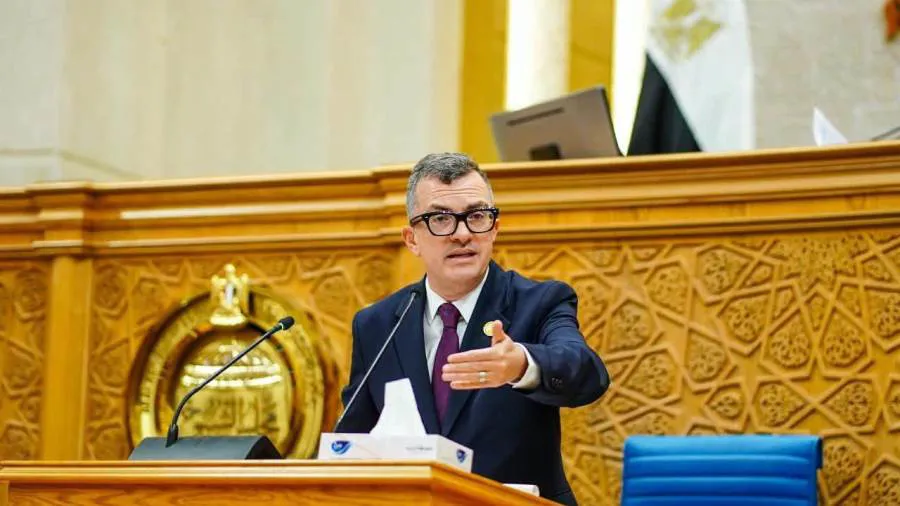
Dr. Ahmed Rostom, Minister of Planning and Economic Development, took part in the Senate's plenary session held today, Monday, 26 October 2026, chaired by Counselor Essam Farid, Speaker of the Senate, and attended by Counselor Hany Hanna, Minister of Parliamentary Affairs. The session discussed the results of efforts to restructure the National Investment Bank and reviewed the details of the "Infrastructure Financing Guarantee Facility", as part of the government's policy of diversifying innovative financing tools to ease the burden on the state budget.
Dr. Rostom stressed the importance of separating the National Investment Bank's role in governing public investment and monitoring the economic and social development plan from its other role of investing its own resources. He noted that the bank performs the first role, monitoring the economic and social development plan, efficiently and effectively, and that work is under way to develop the bank in this respect and to link the Ministry of Finance, the Ministry of Planning and the National Investment Bank electronically to track public investment, a link that has already been in place for four months.
He added that the other role is the bank's investment function, investing its resources in new projects, which is the domain of development finance. He noted that since 1990, 10 years after the bank was established in 1980, financial overlaps had built up between the bank and its debtor entities, which required solutions for settling the National Investment Bank's debts and resolving these financial overlaps. Settlements worth EGP 401.9 billion, representing more than 95% of non-performing assets, have already been completed since February 2026.
"Our goal is for the National Investment Bank to become a development finance institution, and to develop the governance and legislative mechanisms that enable the bank to play this role, as well as to offer innovative solutions for infrastructure projects, including the Infrastructure Financing Guarantee Facility in partnership with the World Bank and several other international institutions," the planning minister said.
Dr. Rostom said the state has made integrated efforts in recent months to restructure the National Investment Bank under a comprehensive plan aimed at settling financial overlaps and debts with government entities, alongside financial and administrative restructuring to strengthen the bank's financial position, reinforce its role in implementing the economic and social development plan and mobilise private-sector investment.
The Minister of Planning and Economic Development revealed that since February 2026, historic debt settlements and the unwinding of financial overlaps worth EGP 401.9 billion have been completed with several entities, most notably the General Authority for Reconstruction Projects and Agricultural Development, the Egyptian Agricultural Authority, the subsidiaries of the Holding Company for Water and Wastewater, the National Media Authority, the New Urban Communities Authority and the General Authority for Industrial and Mining Projects.
He explained that these settlements have strengthened the bank's financial position and lifted a heavy financial burden from these entities, enabling them to move ahead with their development plans.
Dr. Rostom noted that the settlements resulted in the transfer of ownership of a number of assets and plots of land to the National Investment Bank, adding that various mechanisms for partnering with the private sector are now being studied to make the most of these assets and achieve the highest possible investment and development return from them.
He stressed that the restructuring also includes completing the linkage and integration of the databases of the Ministries of Planning and Economic Development and of Finance with the bank, and directing the efforts of the bank and its affiliates, within their work plans, towards supporting and developing the entrepreneurship and startup sector.
The Minister of Planning and Economic Development noted that, among the final recommendations of the "Egypt Forum", held under the patronage and in the presence of President Abdel Fattah El-Sisi, and based on the President's directive, the Ministry of Planning and Economic Development was tasked with launching an initiative under his patronage aimed at producing at least (5) Egyptian billion-dollar companies (unicorns) over the next five years. He confirmed that the ministry immediately began taking the necessary steps and consultations for implementation, and that full details of the initiative will be announced by mid-December, alongside the launch of the National Programme for Economic Transformation.
Separately, the minister reviewed the details of the "Infrastructure Financing Guarantee Facility (IFGF)", explaining that it implements the political leadership's directives to devise new financing paths in partnership with the private sector and in coordination with the Ministry of Finance, to ease the financing burden on the state budget. He described the facility as a specialised national platform for managing and mitigating credit risk, developed in cooperation with the World Bank Group and drawing on successful international experience.
Dr. Rostom explained that the facility offers long-term financing alternatives in local currency, which directly helps reduce exchange-rate risk and lessens reliance on direct sovereign guarantees. He added that in its first phase the facility aims to finance vital private-sector projects, led by renewable energy and water and wastewater projects, in coordination with the relevant ministries.
The minister concluded his statement to the Senate by reiterating that the final recommendations of the "Egypt Forum", recently held under the patronage and in the presence of President Abdel Fattah El-Sisi, explicitly called for the swift launch of this facility as a national platform for innovative financing. He affirmed that the ministry is now working flat out with international and national institutions to accelerate the actual launch as soon as all the required regulatory procedures are completed.

Comments
No comments yet. Be the first!