
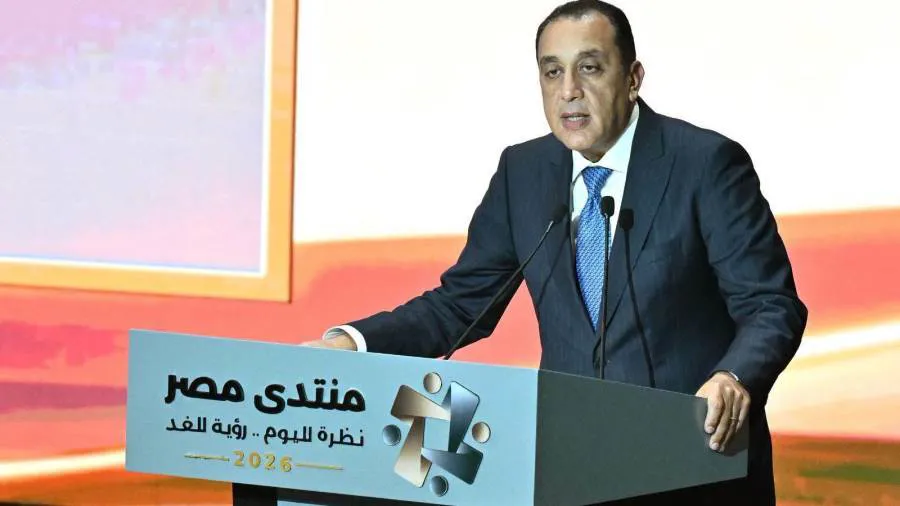
Prime Minister Dr. Mostafa Madbouly delivered a speech at a session on the "National Economic Transformation Programme" on the fourth day of "Egypt Forum 2026", held under the directives of President Abdel Fattah El-Sisi from 19 to 24 October in the New Administrative Capital.
The Prime Minister opened by expressing his pleasure at attending the session to present the main features of the National Economic Transformation Programme for 2027–2030. He said only the broad outlines would be presented, since the vast body of detail prepared and finalised over the past months with the participation of many experts and specialists could not fit into the session, alongside the presentations by the Central Bank governor and the ministers concerned.
Dr. Madbouly noted that the comments of experts and specialists had been taken into account, with the programme revised more than once to address any concerns before reaching its current version. Nor does the process end there: over the next two months there will be full scope for community dialogue on the programme, so that new proposals on its details can be put forward, and the government hopes to have finalised every aspect of the programme by the end of December.
Continuing his outline of the programme, the Prime Minister said the state had adopted a number of fiscal, economic and structural reform programmes in cooperation with several institutions, including the World Bank and the European Union, with one clear goal in mind: putting the national economy on the right track. He noted that the latest programme with the International Monetary Fund will end in December, which prompted many questions from experts about the next steps once cooperation with the Fund concludes. That called for an explanation of the government's aims, chiefly to preserve the economic gains Egypt has achieved. Comparing 2014 with 2026, he said economic growth stood at 2.9% in fiscal year 2013–2014 and reached 5.1% in the most recent fiscal year, despite the current global challenges. On the primary balance, in 2014 revenues were 3.9% lower than expenditure excluding debt service, whereas there is now a primary surplus of 4.9%, meaning resources exceed expenditure by that margin, a significant and tangible shift achieved through governance, spending rationalisation and support for the private sector.
Dr. Madbouly explained that the overall deficit (the gap between revenue and expenditure) stood at 12% in 2014 and fell to 5.8% in the latest fiscal year, 2025/2026. Foreign reserves stood at USD 16.7 billion in fiscal year 2013/2014 and, through considerable efforts by the Central Bank governor, rose to USD 57.3 billion by the end of September. Foreign direct investment, which was USD 4.1 billion a year in 2014, reached USD 18 billion injected into the Egyptian economy last year.
Commenting on these figures, the Prime Minister said that despite the marked improvement in these indicators, major structural challenges remain. The overall deficit of 5.8% is still a challenge even though it has fallen from 12%. Household purchasing power has declined because of inflation and rising prices, a major challenge in itself. Debt service has risen to EGP 2.3 trillion in this year's budget, domestic savings capacity is weak at 3% of GDP, and the population grew by about 25 million between 2014 and 2026, with all the additional burdens that entails.
Dr. Madbouly said that with the IMF programme ending, a new programme had to be put in place. It was not drawn up behind closed doors, nor by the government alone, but through a participatory and integrated approach, as an economic transformation programme that builds on these gains and strengthens economic policy coordination, with the government and the Central Bank working in full coordination as a single team.
He said the international experience of countries that had been in circumstances similar to Egypt's, had programmes with the IMF and other international institutions, and then decided to prepare their own national programmes had been studied. The programme also builds on all previous experience and accumulated work, including the National Dialogue, the national narrative, the structural reforms programme, the State Ownership Policy Document and the recent academic study known as the Oxford Guide, all of which were taken into account in drafting the new programme.
He stressed that the aim is a clear, integrated national economic programme that speaks to every segment of society, meets the needs of Egyptian citizens and earns the confidence of experts and international economic institutions. He explained the difference between economic reform and economic transformation: in the economic literature, economic reform means achieving a degree of macroeconomic stability, strengthening the economy's ability to adapt to and deal efficiently with shocks, and stabilising the exchange rate.
Speaking further about the programme, the Prime Minister said: when we discussed this with experts in the field, they asked what was new about the Egyptian programme. We explained that through the economic transformation programme we aim to raise the economy's productivity, make the private sector more empowered and more deeply competitive, particularly in regional and global supply chains, strengthen human capital, focus on supporting the middle class, which has suffered in recent years, and boost and maximise the returns on assets.
The Prime Minister continued: over the past twelve years we have succeeded as a state in building a larger base of assets and extensive infrastructure, and we are now working to maximise their benefit and to double the fiscal space from which we fund all the services that affect citizens' lives. He added that the programme rests on several main pillars: an integrated economic framework that paves the way for genuine economic transformation, with full consistency between fiscal and monetary policy and between government policy and that of the Central Bank of Egypt; concrete measures to raise incomes, create more jobs and improve services; and greater fiscal space through spending governance and the channelling of resources towards human priorities, with revenue mobilised by broadening the tax base rather than by imposing new taxes.
In this context, the Prime Minister said many had asked about the nature of governance measures after the IMF programme and whether they would continue. He affirmed that these measures will continue, and on a larger scale, noting that there will be caps on external and domestic debt, caps on sovereign guarantees, and sukuk for public investment, so that the private sector can take the largest share of total investment. He added that the new programme will be made binding by a national decision, issued either by the government or by the President of the Republic, with clear and specific mechanisms for monitoring and evaluating the programme involving all the relevant bodies and groups.
The Prime Minister said: the state has clear targets for this new programme that will be achieved. With growth now at 5.1%, we aim to reach a growth rate of 6.8% in fiscal year 2029/2030. Total investment, currently 12.7% of GDP, is targeted to reach 20%, and the private sector's share of investment is targeted to rise from 57.7% to 67%. We also aim to lift tax revenue from 13% to 15% of GDP, bring inflation down from 13.3% to just 5% to 7%, and cut the current-account deficit from 5.1% to 2.3% of GDP. He noted that interest payments relative to revenue are seen as a major problem, since interest now absorbs 67% or 68% of revenue, and that this will fall to 43%. He added that the state is also working to keep reducing unemployment, from 5.8% to 5.5%.
Dr. Madbouly stressed that all of this will be achieved through several main pillars: commitment to a flexible exchange rate, broadening the tax base, strengthening the role of the private sector, reorganising the state's role in the economy, focusing on target sectors to raise productivity, and promoting exports, helping create better jobs for Egyptians. Human development will also be a focus, by creating additional fiscal space in the state budget to spend on education, health, housing and all the services Egyptians hope to see expanded and improved in the coming period.
Prime Minister Dr. Mostafa Madbouly explained that the National Economic Transformation Programme aims to deliver a tangible improvement in Egyptians' living standards by improving incomes, services and quality of life, as well as raising employment, providing decent jobs and increasing women's participation in economic activity.
The Prime Minister added that the programme pays particular attention to improving the basic services provided to citizens, especially in education, health and housing, making them easier to access and more widely available online, while taking their cost into account and ensuring they are available to all segments of society.
Dr. Madbouly said the programme also includes raising the minimum wage in the public and private sectors and increasing the personal tax exemption threshold for workers nationwide. He stressed that these pillars are the programme's main targets for improving citizens' living conditions, strengthening their ability to meet their needs and delivering a direct, positive impact on their quality of life.
Comments
No comments yet. Be the first!