
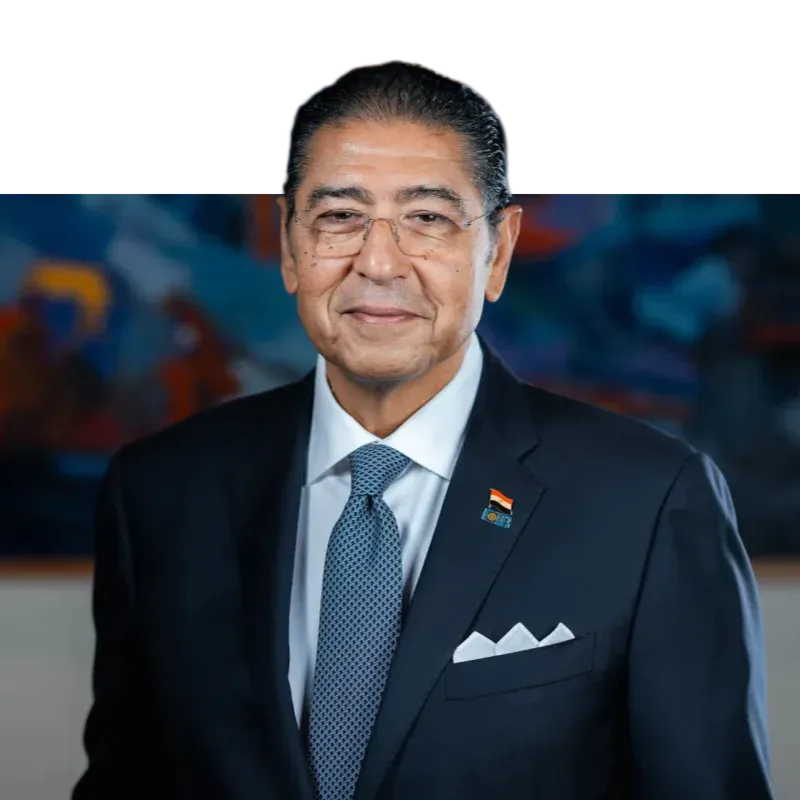
From his return to the board to leading the bank's executive management, this report tracks the development of Commercial International Bank's financial indicators, share price, awards and foundation.
Hisham Ezz Al-Arab's name is tied to key milestones in the history of Commercial International Bank (CIB), from its years of expansion in Egypt's banking market to its presence in international capital markets. In the current phase, Ezz Al-Arab returned to the bank through its board of directors in late 2022, became chairman in March 2023, and then returned to executive leadership as CEO and board member in November 2024.
His return came as the banking sector faced successive changes in interest rates and the exchange rate, and a growing need to balance growth with maintaining strong financial positions.
Ezz Al-Arab's relationship with the bank did not begin with his latest return. He joined CIB in 1999 and served as chairman and managing director from 2002 to 2020. During the period when he stepped away from the bank's direct management, he founded a consultancy and served for a time as an adviser to the Governor of the Central Bank of Egypt in 2022. He then gradually resumed his role at CIB, starting as a non-executive board member and rising to the post of CEO.
This sequence matters when looking at the bank's results: the 2023 figures and most of 2024 were achieved while he chaired the board, whereas his responsibility for direct executive management began in November 2024. The bank's results also reflect the work of an entire institution under changing economic conditions, so each figure needs to be placed in its own period and context.
Profit growth and expanding business volume
The bank's official financial indicators show notable expansion in recent years. Net profit rose from about EGP 16.1 billion in 2022 to EGP 28.8 billion in 2023, then EGP 55.43 billion in 2024, reaching EGP 81.81 billion in 2025. Over the same period, the bank's assets grew from about EGP 633.6 billion to EGP 1.44 trillion, while deposits climbed from EGP 530.1 billion to EGP 1.105 trillion.
The expansion extended to lending, with net loans and facilities rising from about EGP 218.633 billion at the end of 2022 to EGP 541.4 billion at the end of 2025. The capital adequacy ratio stood at 27.3% at the end of 2025, according to the indicators published by the bank. These results reflect growth in the size of the balance sheet and the business, though it is important to distinguish between nominal growth and growth excluding the effect of exchange-rate changes, especially for items linked to foreign currencies.
Growth continued in the first half of 2026, with the bank posting net profit of EGP 39.2 billion, up 17.4% on the same period of the previous year. Consolidated assets reached EGP 1.68 trillion at the end of June 2026, with deposits of about EGP 1.30 trillion and gross loans of EGP 631.3 billion.
Alongside the growth, first-half results showed a non-performing loan ratio of 1.49% of total loans, with coverage of 358%, while capital adequacy reached 28.4%. Together these indicators give a fuller picture of the bank's performance, combining higher lending activity with portfolio quality and capital strength. The gross loans figure announced for June 2026 differs from the net loans and facilities figure in the annual indicators, so the two figures do not form a single accounting series that can be compared directly.
Digital expansion and Yomo
Digital services have emerged as one of the growth tracks in the current phase. According to first-half 2026 results, the number of users of the bank's digital platforms reached 2.2 million, while the value of transactions carried out through digital channels rose 55% year on year. This reflects customers' wider use of electronic banking services, in parallel with growth in the bank's other businesses.
In August 2026, the bank announced it had received preliminary approval from the Central Bank of Egypt to establish Yomo, a digital bank, with a stated investment of USD 300 million in its digital banking platform. The step marks a move towards a standalone digital banking model, but according to the official announcement it is still at the establishment stage; its actual impact on the group's business will become clear once procedures are completed, operations begin and measurable financial results are released.
The CIB Foundation and a long-standing focus on children's health
Beyond banking, Hisham Ezz Al-Arab's name is linked to the CIB Foundation, which he founded in 2010 and whose board of trustees he chairs. The foundation focuses on improving access to healthcare and nutrition for children from the neediest families, working with medical institutions and government and civil-society bodies across the governorates. According to data published by the bank, its initiatives have reached about 8 million children since its founding.
Ezz Al-Arab's interest in this area shows in his continued leadership of the foundation and in the partnerships it builds to support children's treatment and improve the services they receive. Among the most prominent is the partnership with the Magdi Yacoub Heart Foundation, whose 15th anniversary the two foundations celebrated in May 2025. At the event, Ezz Al-Arab, as the bank's CEO and chairman of the foundation's board of trustees, stressed the importance of making healthcare available to less fortunate children as a core focus of the foundation's work.
The foundation's activities are funded by an allocation from the bank equal to 1.5% of its annual net profit, along with donations, according to reports by the bank and the foundation. The resources go to initiatives including support for treatment, provision of medical equipment and development of children's healthcare facilities. This places the foundation's role within CIB's long journey: the bank's presence is not limited to its financial results but includes health projects aimed at making a direct difference to the lives of beneficiary families.
CIB shares on the Egyptian Exchange
Commercial International Bank's shares, listed on the Egyptian Exchange under the ticker COMI, are widely followed by investors. The bank's data show the share's closing price rose from EGP 41.5 at the end of 2022 to EGP 72.7 at the end of 2023, then EGP 78.5 at the end of 2024 and EGP 103 at the end of 2025. Over the same period, the bank's published market capitalisation rose from about EGP 123.7 billion to EGP 347.9 billion.
These figures show the development of the share price and market value on specific dates, but on their own they do not represent the total return to shareholders: the bank's data indicate that the published prices are not adjusted for stock dividends, and the number of shares also changed during the period. The share's performance is also affected by the bank's results, investor expectations and market conditions, as well as general economic variables.
Personal awards and international recognition for the bank
The period since his return has seen Ezz Al-Arab receive a number of awards linked to his career. In May 2023, he received the Lifetime Achievement Award from African Banker, followed by the Lifetime Achievement Award from Global Finance in March 2025, and MEED then named him CEO of the Year in June 2025, according to the biography published on the bank's official website. These awards honour his long banking career, including his earlier years leading CIB and the current phase.
For the bank itself, its 2025 awards include honours in SMEs, sustainable finance, cash management and digital services, as well as Euromoney's Best Bank in Egypt and Best Digital Bank in Egypt awards. In February 2026, CIB announced it had been honoured at the Egyptian Exchange with the award for Best Bank for Sustainable Finance in Africa 2025, confirming its continued presence in regional and international awards.
Thirty years of global depositary receipts
In 1996, according to the London Stock Exchange, Commercial International Bank became the first Egyptian company to offer its shares on international markets through a global depositary receipt (GDR) programme. The programme gave international investors access to the bank's shares through the London market, marking an important milestone in CIB's history and its ties with global capital markets.
To mark thirty years since the programme's launch, the bank celebrated with the Egyptian Exchange on July 14, 2026 at a bell-ringing ceremony at its historic headquarters in downtown Cairo. The event was attended by Hisham Ezz Al-Arab and senior executives of the bank and the exchange, along with representatives of institutions connected to international markets. On September 25, 2026, the London Stock Exchange in turn celebrated thirty years of CIB depositary receipts on its market. These were two separate occasions commemorating the same historic event, one in Cairo and the other in London.
The continuation of the depositary receipt programme over three decades gives it a significance beyond being the first of its kind: it reflects an ongoing relationship with international investors and the accompanying requirements for disclosure, governance and regular communication with the markets. The anniversary comes as the bank expands at home and works to add a new digital banking business, while maintaining its presence on the Egyptian Exchange and the London market.
Between the balance-sheet figures, the share's performance, the awards and the foundation's projects, the shape of the current phase of Hisham Ezz Al-Arab's journey with CIB emerges. He first returned to a governance role, then moved to leading the bank's day-to-day business, while the foundation he established continues its work supporting children's health. Results for 2025 and beyond remain the clearest indicator of his period of direct executive responsibility, while the celebration of thirty years of depositary receipts places this phase within the longer history of a bank that began building its ties with international investors in 1996.
Comments
No comments yet. Be the first!