
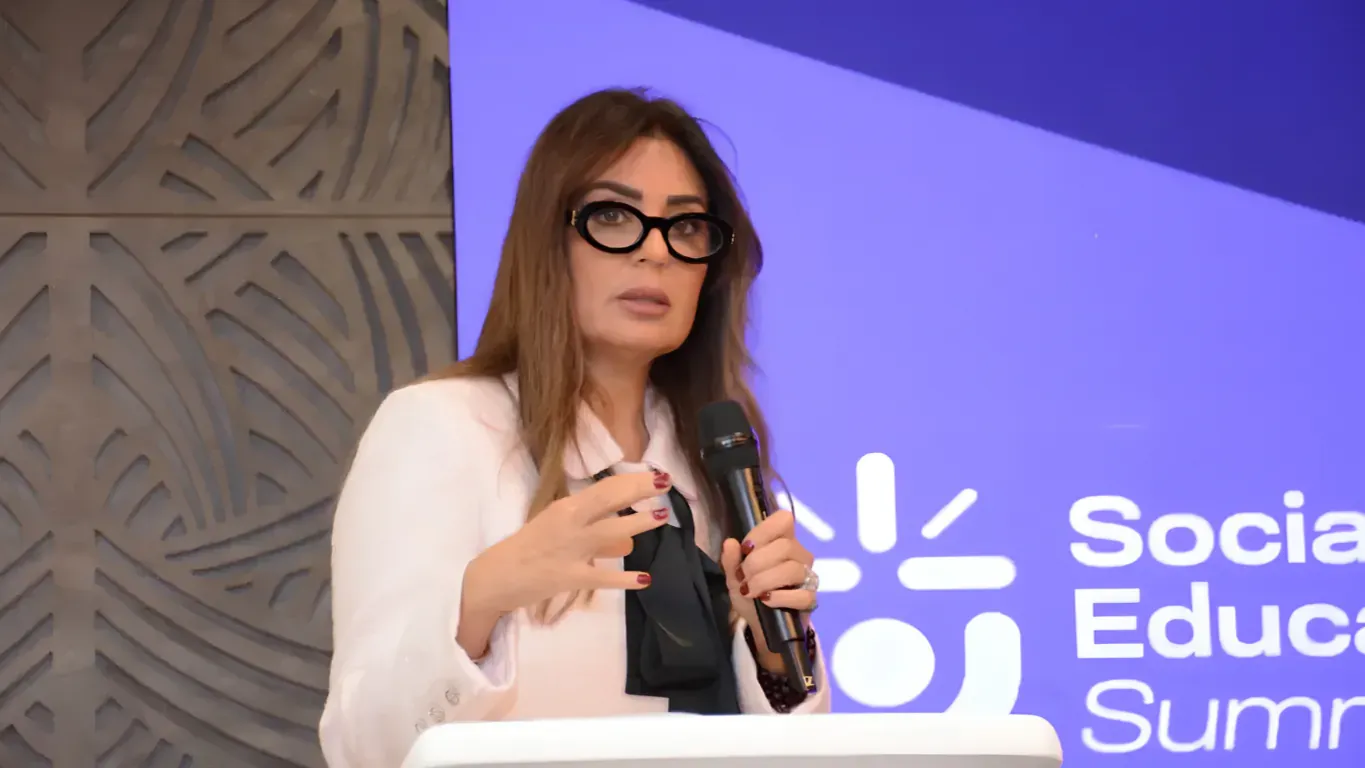
The Central Bank of Egypt (CBE) has reoriented the banking sector’s corporate social responsibility efforts toward strategic community investment, said Ghada Tawfik, Sub-Governor for Corporate Social Responsibility at the CBE. She said the approach uses comprehensive studies and business models to direct funding toward priority projects in education, healthcare and development, with governance requirements and indicators to track results and measure their impact.
Speaking at the Community Education Summit, Tawfik outlined three priorities for the CBE and the banking sector: improving technical education, supporting community schools and providing full university scholarships for high-achieving students. She said around 805 new students joined the university scholarship programme this year, following the award of full scholarships to around 1,150 students last year.
The CBE uses impact assessments to guide project expansion
Tawfik said corporate social responsibility efforts had previously relied on individual initiatives, cooperation agreements and projects, making it difficult to coordinate activities and track results. The CBE began assessing community needs and setting funding priorities to direct resources toward projects that can deliver lasting results and be expanded.
She explained that each project starts with an assessment of beneficiaries’ needs and a business model that sets out how the project will operate and who will implement it. Performance indicators are then used to assess results after implementation begins and determine whether the project can be expanded.
Industry partnerships help prepare technical education students for work
Tawfik identified technical education as the first priority for community investment, citing its role in preparing students for jobs in Egypt and abroad. She said effective school management and industry involvement in training help align what students learn with the skills employers need.
She stressed the importance of training students to international standards and exploring ways to secure recognition of their qualifications abroad, opening up employment opportunities in markets such as Germany and Italy. She cited demand in Germany across healthcare, nursing, construction, transport, education, social services and hospitality, and said training programmes should reflect the needs of each labour market.
Tawfik added that investing in technical education could help reduce unemployment and irregular migration by expanding access to formal employment abroad, which could also support remittances from Egyptians working overseas.
The banking sector supports five technical schools in Helwan
Tawfik said the CBE and the banking sector support the Federation of Egyptian Banks’ initiative in Helwan, which includes five technical schools within the Tahya Misr school complex. She added that several Egyptian banks, including the National Bank of Egypt, support technical schools through their own initiatives.
Mapping out-of-school children would guide community school expansion
Turning to the second priority, Tawfik described one-classroom schools as a low-cost model for villages and areas with limited access to education. These schools offer children who have never enrolled or who have dropped out a chance to resume their education. She said children should also receive support to discover their abilities and develop their skills.
She said expansion should begin with identifying out-of-school children and mapping existing schools and their coverage across governorates. This would help determine which villages have the greatest need for additional schools.
Tawfik proposes turning community schools into village learning and development centres
Tawfik proposed developing one-classroom schools into local learning and development centres that provide education and awareness programmes for children, mothers and young people, alongside initiatives that support family health and economic empowerment.
The proposal includes reviewing curricula with the Ministry of Education and relevant stakeholders, training teachers and school staff, and assessing their readiness after training. It also calls for teaching children basic computer skills, providing space for sports and giving students opportunities to try different activities and discover their talents.
The plan also envisages working with the Ministry of Health to identify services available at village health units, assess families’ access to health insurance and improve access to care for children and their mothers, including vaccinations and routine check-ups.
Tawfik said helping mothers start small home-based businesses could make it easier for families to keep their children in school. She also proposed using community school classrooms for adult literacy classes and awareness sessions for parents, tailored to the needs of each village.
“We are doing more than developing a school. We are creating a new opportunity for an entire village,” Tawfik said.
Proposed pilot would start with 10 schools across three governorates
Tawfik proposed a three-phase rollout, starting with 10 schools in three governorates. The pilot would cover villages with different needs to test how well the model works in each setting. Subject to the results, the second phase would expand the programme to 50 schools, followed by 100 in the third phase, paving the way for a nationwide rollout.
She called on each participating group to support five community schools. She said evaluating the pilot could help replicate the approach elsewhere in Egypt and provide a model that could be adopted across the region.
Proposed measures of success include gains in reading, writing and numeracy, better attendance, lower dropout rates, improved teacher performance and more girls progressing to the next stage of education. The pilot would also track improvements in students’ digital and life skills.
Full university scholarships reach around 805 new students this year
Tawfik said university education is the third priority for the banking sector’s community investment efforts. The CBE helped students affected by the suspension of US Agency for International Development (USAID) scholarships under an American University in Cairo programme to continue their studies. The CBE drew on that experience to launch an Egyptian scholarship programme with the Ministry of Higher Education.
Now in its second year, the university scholarship programme awarded full scholarships to around 1,150 students last year and welcomed around 805 new students this year. High-achieving Egyptian students can apply online after completing secondary school.
Tawfik said the first cohort of the Future Scientists Scholarship, implemented with the Ministry of Higher Education, included 1,763 students. It included students from families receiving support through the Takaful and Karama programme, students from schools for high achievers in science and technology (STEM), and students with disabilities.
She said applicants are selected in cooperation with the ministry through document checks, eligibility reviews and assessments of their reasoning skills. The scholarship aims to prepare students to continue their academic careers in Egypt or abroad and help develop a new generation of Egyptian scientists.
Scholarships cover tuition, housing and living expenses
Tawfik said the scholarships cover tuition at Egypt’s national universities, as well as accommodation and living expenses. Stipends are paid into bank accounts opened for recipients.
Support continues throughout students’ university studies and includes English-language training and personal skills development alongside their academic coursework.

Comments
No comments yet. Be the first!