
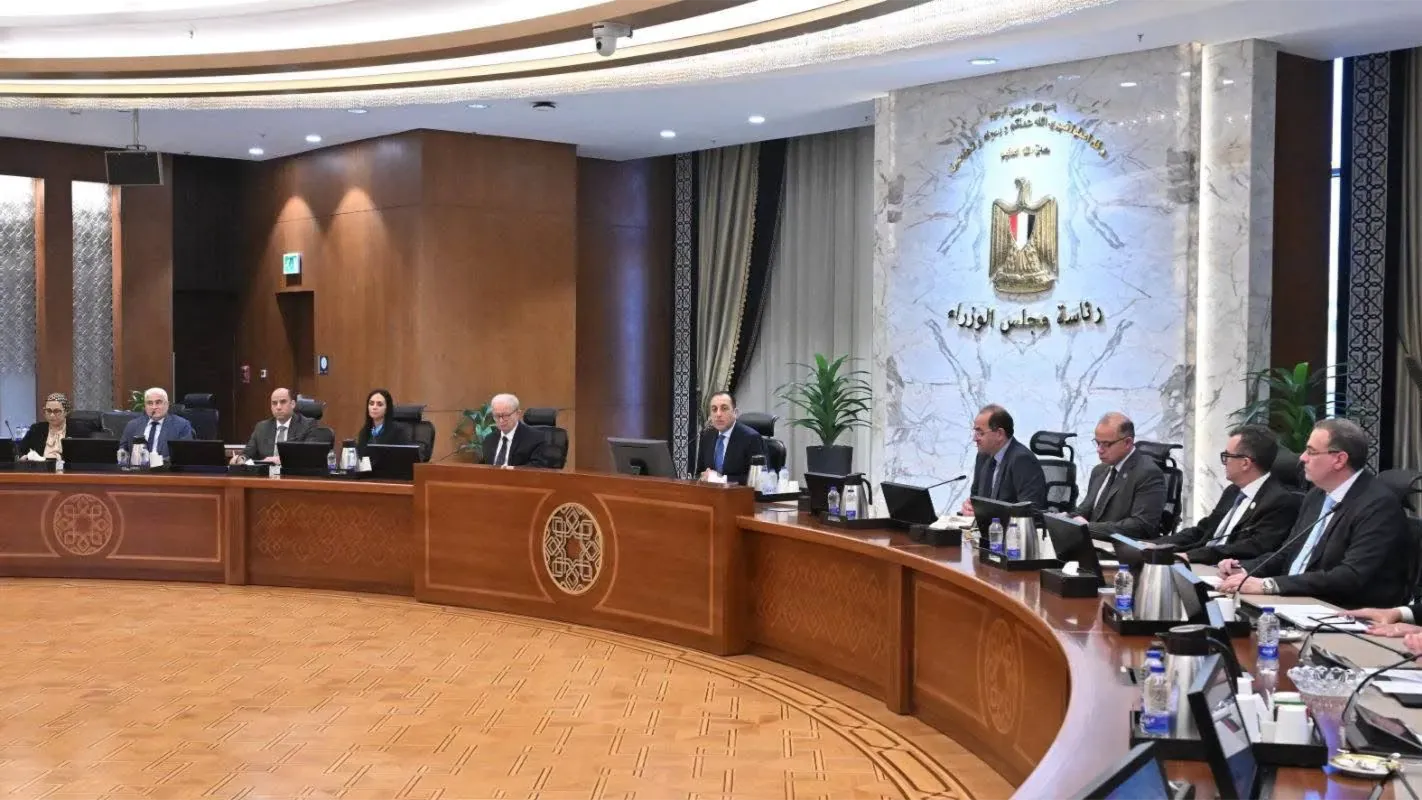
Prime Minister Dr. Mostafa Madbouly today chaired a meeting of the National Council for Wages, attended by Dr. Hussein Eissa, Deputy Prime Minister for Economic Affairs; Ahmed Kouchouk, Minister of Finance; Dr. Maya Morsy, Minister of Social Solidarity; Dr. Mohamed Farid Saleh, Minister of Investment and Foreign Trade; Hassan Raddad, Minister of Labour; Dr. Ahmed Rostom, Minister of Planning and Economic Development; and Engineer Khaled Hashem, Minister of Industry.
The meeting was also attended by Major General Gamal Awad, Chairman of the National Organization for Social Insurance; Engineer Hatem Nabil, Head of the Central Agency for Organization and Administration; Counsellor Amal Ammar, President of the National Council for Women; Major General Engineer Akram Ahmed El-Gohary, Head of the Central Agency for Public Mobilization and Statistics; Dr. Samar El-Ahdal, Deputy Minister of Foreign Affairs for International Cooperation; and Dr. Mohamed Awad, Chief Executive Officer of the General Authority for Investment and Free Zones.
Also participating were Ahmed El-Wakil, President of the Federation of Egyptian Chambers of Commerce; Engineer Mohamed Zaki El-Sewedy, Chairman of the Federation of Egyptian Industries; Hossam El-Shaer, Chairman of the Egyptian Tourism Federation; Abdel Moneim El-Gamal, President of the Egyptian Trade Union Federation; Engineer Mohamed Sami Saad, Chairman of the Egyptian Federation for Construction and Building Contractors; Engineer Alaa El-Sakty, Chairman of the Federation of Small and Medium Enterprise Investors; and Dr. Osama Hafeila, Vice President of the Egyptian Federation of Investors Associations and Institutions.
At the outset, the Prime Minister welcomed participants to the exceptional meeting of the newly constituted National Council for Wages, underscoring the government’s strong commitment to improving wage levels nationwide.
Madbouly noted that the government had already taken steps to raise the minimum wage. He explained that, given the private sector’s share of total employment, he was keen to attend the meeting to support compliance with the private-sector minimum wage and had directed the Minister of Planning and Economic Development to address the matter. He also highlighted President Abdel Fattah El-Sisi’s directives to improve citizens’ incomes across the country.
During the meeting, the Minister of Planning and Economic Development reviewed the composition of the National Council for Wages under the new Labour Law, No. 14 of 2025. He explained that Article 101 provides for a tripartite structure representing the government, employers’ organizations and workers’ organizations.
Chaired by the minister responsible for planning and economic development, the council includes representatives of the ministries of Labour, Finance, Supply and Internal Trade, Social Solidarity, and Industry. It also includes the National Council for Women, the Central Agency for Public Mobilization and Statistics, the Central Agency for Organization and Administration, the General Authority for Investment and Free Zones, the National Organization for Social Insurance, and the National Council for Persons with Disabilities.
The council also comprises six members representing employers’ organizations, selected from those with the largest membership, and six members representing the most representative trade union organizations. The latter are nominated by their organizations, with representation across all relevant trade union levels taken into account.
The Minister of Planning and Economic Development presented key indicators of Egypt’s labour market, including trends in labour force participation. He noted that participation rates have recovered in recent years after declining through 2020, although a gap remains between male and female participation in economic activity, despite a relative improvement in women’s participation in recent years.
The minister also addressed employment rates, explaining that their improvement creates an opportunity to move beyond increasing employment numbers toward improving earnings from work. Efforts are therefore being made to raise workers’ incomes and living standards while expanding women’s access to employment opportunities. He added that declining unemployment rates among both men and women reflect an improvement in labour market performance.
Dr. Rostom also reviewed key private-sector indicators and employment trends. He noted that the private sector employed approximately 26.5 million people, both within and outside establishments, out of a nationwide total of around 32 million employed people in 2025. The number of private-sector establishments stood at nearly four million, including both formal and informal businesses.
He also reviewed major economic indicators, particularly inflation and real gross domestic product growth, which form the basis for scenarios used to determine the private-sector minimum wage.
During the meeting, approval was granted to set the private-sector minimum wage at EGP 8,500, effective January 1, 2027.
The Minister of Finance said the government’s proposed plans to increase citizens’ incomes over the coming years would be presented for discussion and agreement with private-sector representatives, allowing decisions to be taken jointly.
Accordingly, the Prime Minister directed the formation of a working group comprising government officials and private-sector representatives on the National Council for Wages to examine proposals for raising wages and improving workers’ incomes across the country’s various sectors through 2030.
The meeting also approved raising the minimum hourly wage for workers performing work that is temporary by nature, or those working part-time, to a net EGP 34 per hour.
Approval was also granted for the annual periodic wage increment. Beginning in the 2027 financial year, according to each establishment’s accounting year, the minimum annual periodic increment in the private sector will be at least 3% of the wage used to calculate social insurance contributions, as stipulated in the Social Insurance and Pensions Law, with a minimum increase of EGP 350.

Comments
No comments yet. Be the first!